
Why Did Your Danish Ancestors' Last Names Change?
Have you ever wondered why your Danish ancestors' last names kept changing? You might find a man named Jens Hansen, then discover his son called Peder Jensen, and then a daughter recorded as Maren Jensdatter. At first glance, it can feel like you have lost the family entirely.
Don't give up! What you are seeing is the old Danish patronymic surname system. The good news is that what might seem like a roadblock is actually a key to unlocking your family history. Once you understand how this system worked, you will be able to research your Danish ancestors with much more confidence.
In a hurry? Check out the FAQ at the bottom for the short answers.
How Patronymic Surnames Worked
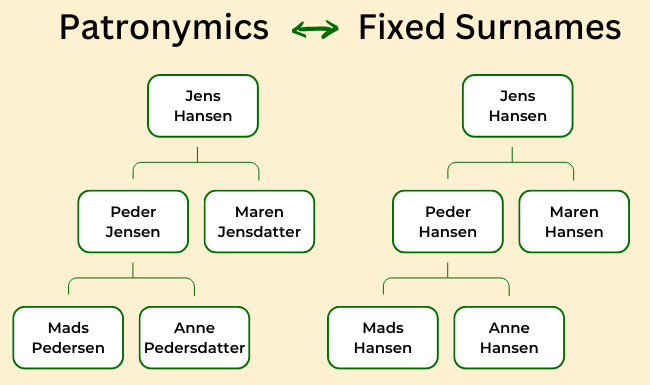
For centuries in Denmark, surnames were not fixed the way they are today. Instead, a child's last name was built from the father's first name:
If a man named Jens Hansen had a son named Peder, the boy became Peder Jensen, literally "Peder, Jens's son."
If Jens had a daughter named Maren, she would be Maren Jensdatter, meaning "Maren, Jens's daughter."
The same rule applied to Peder's children, for example, Niels Pedersen and Anne Pedersdatter.
The image above shows the difference between patronymics and fixed surnames.
From the late eighteenth century, the use of the -datter ending became less common. Instead, both sons and daughters would get the -sen ending. You will sometimes see both forms in records for the same person, for example, Maren Jensdatter might also be written as Maren Jensen.
Danish Laws About Fixed Surnames
1828: Choose a Fixed Surname!
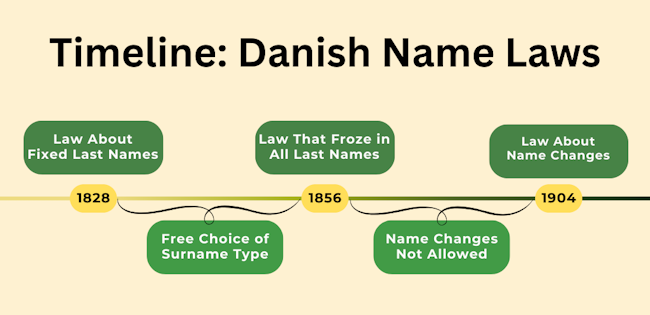
In 1828, a royal decree ordered Danish families to pick a fixed surname. The government's goal was simple: Fixed surnames made taxes, military service, and record-keeping a lot easier.
Most families froze their current patronymic surname in place. For example, if a man was named Niels Andersen at the time, his children became Andersen, too, whether they were sons or daughters. Others decided to lock in a farm name or another distinctive surname.
From that point on, surnames were supposed to stay the same across generations, but some families delayed adoption of fixed surnames, particularly in rural areas. Part of it was tradition. For some, it was about the meaning of the name. It made no sense for a man named Hans to call his son Jensen, because that meant "son of Jens."
1856: Locking In Surnames
The 1828 law gave families a choice, but many families chose to use a patronymic surname, resulting in too many same-named people. As a result, the government felt the need for a stronger mandate to enforce fixed surnames. That came in 1856, when the government sent a decree to all bishops in Denmark, ending the free choice of surnames. The surname that was in use was locked in for present and future generations. No name changes were allowed.
1904: Allowing Name Changes
A new law was passed in 1904 to allow name changes. In fact, name changes were encouraged to reach the 1828 goal of decreasing the use of surnames formed like patronymics. The parish had to record these official name changes in the person's birth record in the parish register.
Regional Variations and Exceptions
Not every part of Denmark used patronymics in the exact same way. Here are a few differences you might meet during your research:
The Upper Class: Many upper-class Danes, such as nobility, clergy, and wealthy townspeople, chose fixed surnames long before they were mandatory, often Latin or German in style, such as Pontoppidan, Wedel, Brandt.
Farm Names: In rural areas, peasants were sometimes known by the name of the farm they lived on. If the family moved, their "surname" could change, because it was in fact a byname.
Southern Jutland: A law required fixed surnames from 1771 in Schleswig, which covers the northern part of Germany and Southern Jutland in Denmark. Some families in Southern Jutland adopted fixed surnames earlier, following German naming customs. Unlike the rest of Denmark, many families in Southern Jutland chose the farm name or another byname as their new fixed surname.
These quirks can be confusing, but they are also valuable clues when you are trying to pin down the right family.
Practical Tips for Family Historians
If you are working on your Danish genealogy, here are some strategies to help you through the surname puzzle:
Correlate information from multiple sources. Parish registers, census records, probate records, and farm locations will help you confirm that you have found the right family.
Learn the regional quirks. Some areas switched to fixed surnames earlier than others.
Watch out for farm names. They can pop up in records and sometimes even replace the patronymic.
Use every detail. Occupations, ages, witnesses at baptisms, and neighbors in the census can help you connect the dots across generations.
Don't be alarmed if you see spelling variations. The same person's surname may appear as Pedersen or Petersen, depending on the scribe.
Once you know the rules of the patronymic system and the gradual shift after 1828, the name changes that once felt like roadblocks become useful guideposts in your genealogical research.
FAQ: The Danish Patronymic Surname System
Q: Why does my Danish ancestors' last name keep changing in the records?
A: Surnames changed, because Denmark used patronymics, meaning surnames that were based on the father's first name.
Q: When did Denmark switch to fixed surnames?
A: The Danish law about fixed surnames came in 1828, but some families did not fully adopt fixed surnames until decades later.
Q: How can I tell if a surname is a patronymic or a fixed surname?
A: If the surname ends in -sen or -datter before 1828, it is almost certainly a patronymic. After 1828, -sen surnames often became fixed family names.