
Background: Why Denmark Introduced the Name Law
For centuries, Danish surnames followed the patronymic surname system: A child's surname was derived from the father's first name, with "-sen" for sons and "-datter" for daughters. This practice worked well in small, rural communities where everyone knew each other. But as Danish society modernized in the late 18th and early 19th centuries, the system became increasingly impractical.
The Danish government was facing a growing administrative burden. Military conscription, taxation, property records, and the management of civil affairs required stable, unchanging surnames. Patronymics changed from generation to generation. Moreover, many men had a byname, but that name could change over time depending on his residence, his occupation, and other factors. Thus, officials struggled to maintain accurate records.
The solution was the Royal decree of 30 May 1828, which marked a turning point in Danish naming practices. For the first time, Danes were required to adopt fixed, hereditary surnames.
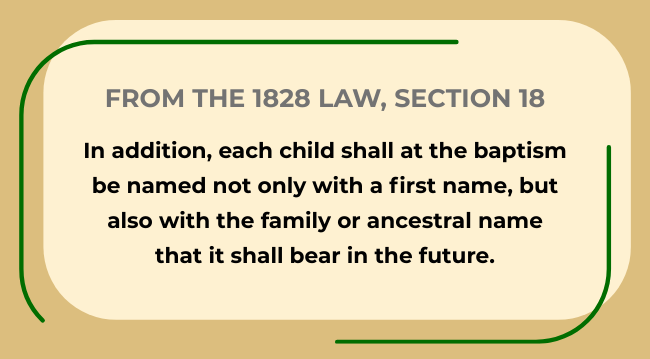
Although we often call it the 1828 name law, its formal title translates to "Regulation on various matters to be observed in relation to the baptism." The requirement to record both a given name and a family name was tucked away in section 18, and the detailed instructions followed in administrative circulars on 4 October 1828 and 30 September 1829.
What the 1828 Surname Law Required
The 1828 name law mandated that children must be given permanent surnames, but that was all the law said. The chancellery sent two circulars to the bishops over the next year to explain the restrictions:
Surname options. The father could choose between the true patronymic, his own byname, a relevant farm or place name, a relevant profession, or a proper surname that he was somehow attached to, e.g. his stepfather's surname.
No new patronymics. A surname could not continue to change with each generation. Once fixed, it had to remain consistent. If the father chose to use a true patronymic, any children of his sons had to use that same surname and not a new, true patronymic.
No use of the -datter ending. Although a true patronymic could be used, daughters could not be named using the -datter ending, only the -sen ending. All children of a couple had to be given the same surname.
Enforcement and Compliance: Rural versus Urban Denmark
In theory, the 1828 law applied universally. In practice, compliance varied.
Urban areas
In Copenhagen and larger towns, where bureaucracy was denser and population mobility greater, enforcement was stricter. City dwellers generally adopted fixed surnames within a generation, as officials relied heavily on consistent names in tax rolls, guild records, and military levying rolls.
Rural areas
In the countryside, enforcement was far looser. Many peasants continued to use patronymics for decades. Thus, the paper trail often reflects a gradual, uneven transition rather than a sudden break in 1828.
This uneven compliance complicates genealogical research today.
Common Mistakes Researchers Make
Several pitfalls arise when interpreting Danish records from the transitional period:
Assuming immediate uniformity. Researchers often expect that all Danes adopted fixed surnames in 1828. In reality, the transition was gradual and inconsistent, especially in rural parishes.
Confusing patronymics with fixed surnames. The name Nielsen recorded in 1835 may be a fixed surname or a true patronymic still in use.
Overlooking spelling variation. Clerks and ministers often used surnames inconsistently, sometimes recording both the patronymic and the new surname in different records for the same individual.
Tracing Families Through the Transition Period
To track Danish families effectively, researchers must understand how the same person might appear under different surnames depending on the context.
Pre-1828 records
Expect shifting patronymics. Most children will carry a different surname than their parents.
Circa 1828 to 1860
Look for evidence of both systems in play. A man might be recorded as Jens Pedersen (after his father Peder) in one document but Jens Vestergaard (after the family's farm) in another. A woman may be recorded as Anne Jensen in one record but Anne Jensdatter in another.
Post-1860
Increasingly, families settled into fixed surnames, though isolated exceptions still appear.
Genealogical Strategies for Handling Inconsistent Surname Use
When researching Danish families during the transition period, consider these strategies:
Note parallel usage. If both a patronymic and a fixed surname appear in records, make a note of both names and search for both names in indexes.
Track by household, not surname. Pay close attention to family groups across censuses and parish records. Names may shift, but family structures remain stable. Document all children of a couple, not only your ancestor.
Examine all relevant sources. Gather information about each person and family from all relevant sources to ensure that you are not climbing someone else's tree.
Correlate all the information. Compare recorded ages, birthplaces, places of residence, occupations, etc., rather than relying solely on surnames.
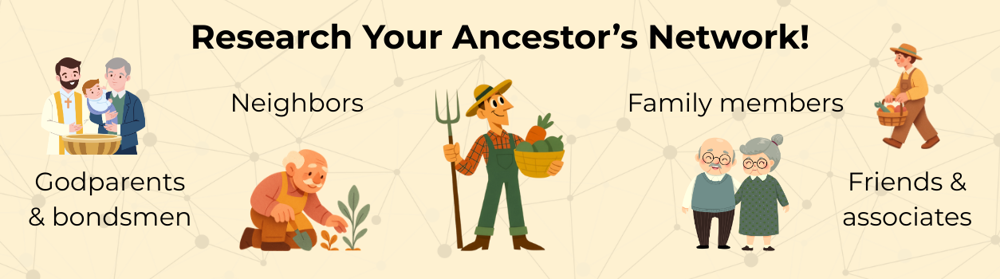
Research the FAN club (friends, associates, and neighbors). Bondsmen and godparents were often relatives. Information about them can help you confirm that you are researching the right family.
Expect exceptions. Some families resisted the law or reverted to patronymics. Keep an open mind when surname patterns seem inconsistent.
The 1828 law about names was not a single event but rather the beginning of a decades-long process of cultural change. For genealogists, this period presents both challenges and opportunities. By understanding the uneven enforcement of the law and the persistence of traditional practices, we can learn how our ancestors navigated through one of the most transformative periods in Danish naming history.