
Why Danish Names Can Challenge Family Historians
Looking at the family tree of a family in eighteenth-century Denmark can be disorienting, if you are new to Danish genealogy. Surnames seem to appear and disappear at random, and sometimes no one in the household has the same surname. The explanation? Danish surnames were patronymics!
This case study demonstrates how patronymics worked in practice by following the lineage from my seventh great-grandmother Anne Hansdatter to her grandchildren, who lived in the 1700s in the town Ravnebjerg in Sanderum Parish, Denmark.
Let's first take a brief look at two Danish words that are essential for the formation of patronymic surnames: Datter, which means daughter, and søn, which means son.
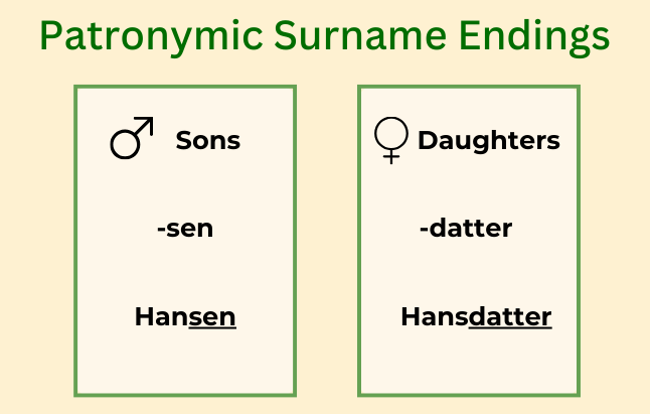
Patronymics ended in one of these two words, depending on the person's gender. The ending -datter was used for daughters, and the ending -søn or -sen was used for sons.
Often double s was not used in patronymics, but sometimes you will see spellings such as Hanssen, Madssen, Nielssen. You may also see the old spelling -daatter for female patronymics.
Case Study of Danish Patronymics in the 1700s
The Starting Point: Anne Hansdatter (c. 1676 to 1751)
My seventh great-grandmother Anne Hansdatter was born about 1676. Her surname reveals one thing about her identity: Her father's given name was Hans.
The ending -datter literally means daughter. Hansdatter means Hans's daughter. Anne Hansdatter's name does not indicate anything about her father's surname, only his given name.
First Marriage: Anne Hansdatter and Hans Pedersen
Anne Hansdatter's first husband was Hans Pedersen. They had at least two children:
Anne Hansdatter, born 1706.
Hans Hansen, born 1711.
Here we see patronymics working in a way that often surprises beginners:
The children had a different surname than their father because their surnames were formed from his given name, Hans, not his surname, Pedersen.
The children had slightly different surnames because one was a daughter (-datter) and the other was a son (-sen).
This is a textbook example of patronymics functioning as customary. Danish surnames were not family names, and the surnames often changed from generation to generation.
Second Marriage: Anne Hansdatter and Claus Nielsen
After the death of her first husband, Anne married Claus Nielsen. Only one child was born from this marriage:
Maren Clausdatter, born 1713.
This child's surname, Clausdatter, reflects her father's given name, Claus. This was how Danish naming conventions worked in the 1700s. A person's surname depended on their father's given name.
The Next Generation: Maren Clausdatter (1713–1785)
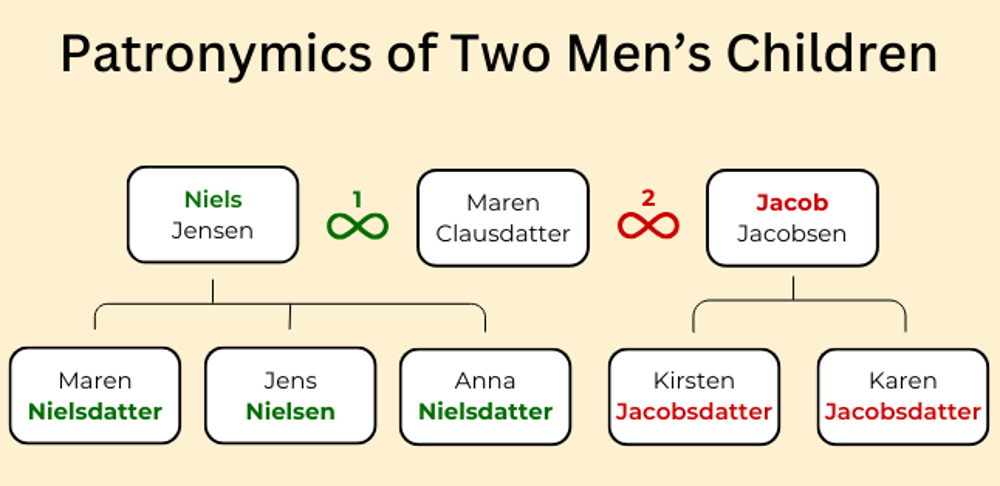
Maren Clausdatter also married twice, and her children's names reflect each husband's given name.
First Marriage: Maren Clausdatter and Niels Jensen
Maren’s first husband was Niels Jensen. Their children were:
Maren Nielsdatter, born 1746.
Jens Nielsen, born 1748.
Anna Nielsdatter, born 1751.
Each child's surname reflects their father's given name, Niels:
The daughters became Nielsdatter.
The son became Nielsen.
Even though Niels's surname was Jensen, none of his children carried that surname. Patronymics reset with each generation.
Second Marriage: Maren Clausdatter and Jacob Jacobsen
After Niels Jensen died, Maren married Jacob Jacobsen. His name tells us that:
He was named Jacob.
His father was also named Jacob.
This repetition was common and perfectly acceptable in the patronymic naming system.
The known children of Maren and Jacob were:
Kirsten Jacobsdatter, born 1753.
Karen Jacobsdatter, born 1756.
Both children were daughters and carried the surname Jacobsdatter, derived from their father's given name, Jacob.
What This Case Study Shows Us About Patronymics
This lineage illustrates two key features of Danish patronymic surnames.
Surnames Were Formed from the Father's Given Name
Children's surnames were formed by adding the ending -datter or -sen to the father's given name, depending on the child's gender. The father's surname played no role in the formation of the child's surname.
Surnames Were Not Family Names
Surnames were not passed down through generations. Fathers and children typically had different surnames. A surname described who your father was, not which family you belonged to.
Why Knowledge of Patronymics Matters for Family Historians
For family historians working with 18th-century Danish sources, this case study demonstrates why patronymics must be read as descriptions, not surnames in the modern sense. Understanding how patronymics worked in practice allows genealogists to:
correctly group children with the right parents,
recognize remarriages, and
avoid assuming family relationships based on shared surnames.
Your surname may be Hansen or Petersen, but that does not mean that you are related to everyone by that name.
When researching Danish ancestors with patronymic surnames, it is best to research them as thoroughly as you would a family named Smith. For practical tips regarding Danish naming conventions, read my blog post From Patronymics to Proper Surnames: Understanding Danish Naming Traditions.
Experienced Research Assistance
I have three decades of experience in researching Danish ancestors. If you are stuck in your research, you can hire me to help you.
I can help you with one ancestor or multiple generations, depending on your wishes. Send me a message or book a free meeting, so we can discuss the possibilities.